

Becoming non UK resident in 2009/2010
As you're probably aware, losing your UK residence status can be a very important tax break. If you're non UK resident you are exempt from UK income tax on overseas income and can avoid UK capital gains tax as well.
Actually determining when you are and when you aren't UK resident can therefore have a big impact on your UK tax bill. Unfortunately the tax legislation is currently pretty silent on this point, and doesn't actually define when a person is or is not UK resident for tax purposes. There is talk of a statutory residence test and in 2008 this was certainly being looked at by HMRC with a draft test being worked on, however nothing to date has been published.
The Revenue have helpfully published guidance on when they will and won't view you are being a UK tax resident. In the past this was generally accepted as representing the current law and was relied on by many people.
There are a number of different classifications of residence but to give you an idea here's an extract from the Revenues guidance:
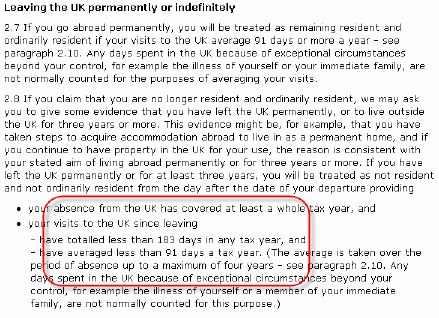
This shows that if you're leaving the UK you'll need to show a permanent departure and that your UK visits were less than 183 days in a tax year and averaged less than 90 days over four tax years.
This was relied on by many UK expat taxpayers who thought that provided they spent less than 90 days in the UK in a tax year (on average) they'd be classed as non UK resident.
The 2008 Finance Act made changes to the counting of days spent in the UK. Before 5 April 2008 the days of arriving and departing the UK are generally ignored. However after 6 April 2008 you'll need to include any day when you are in the UK at midnight - except for qualifying transit days (ie when you are in the UK for a short term to catch an ongoing plane/boat etc). For all intents and purposes this means you include the day of arrival and exclude the day of departurte. This change will be of key concern for anyone making frequent trips back to the UK.
Aside from meeting the 90 day limit there are a number of general principles that it's well worth considering - particularly given Revenue guidance is not set in stone.
The Commissioners considered residence status again in the Gaines Cooper decision. They looked at previous cases and derived a number of principles from these cases. These are still worth considering as they give a useful insight into how the Commissioners approach residence issues.
The Commissioners summary of UK tax residence
- They reiterated that that as there is no definition of residence in the tax legislation it should be given its natural and ordinary meaning. Therefore they stated that being resident means "to dwell permanently or for a considerable time, to have one's settled or usual abode, to live in or at a particular place" . This was taken from the following quote:
'…My Lords, the word "reside" is a familiar English word and is defined in the Oxford English Dictionary as meaning "to dwell permanently or for a considerable time, to have one's settled or usual abode, to live in or at a particular place". … In most cases there is no difficulty in determining where a man has his settled or usual abode, and if that is ascertained he is not the less resident there because from time to time he leaves it for the purpose of business or pleasure. … But a man may reside in more than one place. Just as a man may have two homes -- one in London and the other in the country -- so he may have a home abroad and a home in the United Kingdom, and in that case he is held to reside in both places and to be chargeable to tax in this country…'
- There are no time limits laid down in the statute and therefore it is necessary to take into account all the facts of the case. This will involve the Commissioners looking at the duration of an individuals presence in the UK as well as the regularity and frequency of visits. As one judge has said '…one has to consider not only the time that he is in this country but the nature of his visit and his connection with the country…'
In addition personal and family matters such as birth, family and business ties, the nature of visits and the connections with this country, may all be relevant.
- The availability of living accommodation in the UK is a factor to be borne in mind in deciding if a person is resident here.
- It is quite possible that an individual may be resident in two places at the same time. As shown from the above judicial quote just as a person can have two homes, a person can be resident in two countries. In this case from a UK perspective the Revenue aren't really concerned with the overseas position.
Providing you're resident in the UK you'll be subject to UK taxes.
Therefore the Commissioners said that the fact that an individual has a home elsewhere is of no consequence if there is UK residence.
- They also distinguished between the case where a British subject has established residence in the UK and then has absences from it and the case where a person has never been resident in the UK. This followed on from a judicial quote which stated:
'… If, for instance, such a man is a foreigner, who has never resided in this country there may be great difficulty in holding that he is resident here. But if he is a British subject the Commissioners are entitled to take into account all the facts of the case…'
They therefore open up the possibility that a foreigner could potentially spend periods in the UK without establishing UK residence, but a British subject who was previously UK resident could well be classed as UK resident.
So what does this mean?
Well, in the Gaines Cooper decision the Commissioners classed the taxpayer as UK resident by looking at the circumstances of his periods spent in the UK and his UK connections.
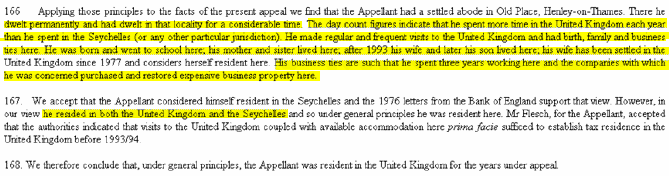
In this case of crucial importance was that the taxpayer spent more time in the UK than anywhere else, had his family here and made regular and frequent visits to the UK. He also had UK available accommodation here and was a British subject.
Therefore if you are a British subject and want to avoid being a UK resident in 2009/2010, when you leave the UK you should:
Ideally you should try and avoid a transient lifestyle where you are spending a significant period of your time in the UK. For example in the Gaines Cooper case at one point he spent 150 days each year in aeroplanes, three or four months each year in Jersey, three or four months each year in the United Kingdom, two weeks in Cyprus, two weeks in Italy, and about six to eight weeks each year in the United States. This clearly gives a strong indication that he still has a strong connection with the UK.
What about UK visits?
In this case the taxpayer originally assessed his UK visits in accordance with the Revenue guidance. Therefore he excluded the days of departure and arrival as well as the exceptional days (eg for a heart bypass operation). As he had many visits to the UK that only lasted two days (ie arrive one day then leave the next) this meant that these days were excluded from his figures that weren't counted when assessing the periods spent in the UK.

The Commissioners recalculated the days spent in the UK in this case and did not ignore the days of arrival in the UK, but instead counted the nights actually spent in the UK. This is now in line with the new provisions in the 2008 Finance Act.
Summary of points to establish non UK tax residence in 2009/2010
- Whilst establishing residence overseas is not necessarily a factor in establishing non UK residence in practice the Revenue are likely to look more favourably on your position if you can point to an overseas country of residence
- Avoid having UK available accommodation
- Avoid a pattern of regular and significant UK visits that suggest a UK lifestyle
- Keep UK visits to an absolute minimum
- Ensure you establish a base for yourself overseas
- Spend more time overseas than you do in the UK
- Move your possessions overseas
- Ensure your family is with you overseas if at all possible
- Consider establishing treaty residence overseas by virtue of having a permanent residence overseas
About the Author
 The Author of this article/answer is our site Editor, Lee Hadnum. Lee is a rarity among tax advisers having both legal and chartered accountant qualifications. After qualifying a prize winner in the Institute of Chartered Accountants exams, he also went on to become a chartered tax adviser (CTA).
He worked in Ernst & Youngs Entrepreneurial Services department for a number of years before setting up his own tax planning practice. He is now a full time tax author.
=============================================================
Disclaimer
=============================================================i) Please note that the articles/answers contain general guidance only and do not constitute accountancy, tax, investment or other professional advice.
ii) The contents of this article/answer are for information only and are intended to assist readers in identify any tax planning opportunities that may be available to them. The information contained in this answer is not intended to be a substitute for taking proper taxation advice and should not be relied upon in this way. Always consult a qualified accountant or taxation adviser. Your situation will then be looked at individually and specific advice relevant to your circumstances can be given. The Expert does not accept responsibility for any loss arising as a result of reliance on any information contained in this answer.
These Notes (and Disclaimer) do not affect your statutory rights in the United Kingdom.
 The Author of this article/answer is our site Editor, Lee Hadnum. Lee is a rarity among tax advisers having both legal and chartered accountant qualifications. After qualifying a prize winner in the Institute of Chartered Accountants exams, he also went on to become a chartered tax adviser (CTA).