

Offshore trusts for grandchildren to avoid UK income tax and CGT
Offshore trusts for grandchildren to avoid income tax and CGT
The opportunities for UK residents to successfully use offshore trusts to avoid UK tax have been significantly reduced over the past few years due to the scope of the anti avoidance rules in place.
In general terms an offshore trust would be effective in avoiding capital gains tax and income tax.
As a non resident 'entity' it would be exempt from UK capital gains tax as well as UK income tax on overseas income. Only UK income would typically be within the scope of UK income tax.
However there are a number of anti avoidance provisions that apply.
Firstly there are provisions that can attribute capital gains to the settlor of a trust where the settlor or his family can benefit.
Therefore any capital gains of trust could be attributed to the person who established the trust where children or grandchildren could benefit.
To get around this you'd need to use a company resident in a country with which the UK has a suitable double tax treaty (such as Mauritius or Singapore). This is explained in a previous article.
You'd be looking at an offshore company owned by a UK resident shareholder and an offshore trust. The UK shareholder would have shares with a majority of the value but a minority of the votes, and the trust, shares with a minority of the value but a majority of the votes.
Ie
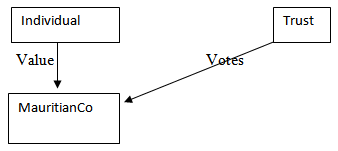
This should then allow the gains in the company to be crystallised without the UK shareholder being attributed the gains.
In terms of the income of the company the anti avoidance rules aren't as wide and there are provisions to attribute income where the settlor his spouse or minor children can benefit.
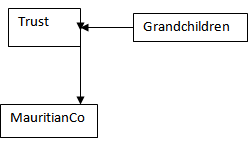
Therefore ensuring that the offshore trust just benefits the grandchildren should still be effective as a shelter from income tax.
In terms of income protection you'd therefore have:
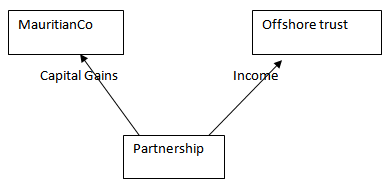
The next issue would be to ensure that the trust received the income (but not capital gains/receipts) and the MauritianCo did not receive the income (to prevent it being taxed on the settlor). One option here would be to use a partnership between the trust and the MauritianCo. Effectively they would sign a partnership agreement specifying an agreed profit and capital sharing ratio.
The income and any capital receipts would flow into the partnership which would then distribute the income and capital payments in accordance to the partnership agreement. Given the restrictions in various double tax treaties on which assets will qualify for the CGT exemption, this could be a good option for holding overseas investments.
Eg:
=============================================================
Disclaimer
=============================================================i) Please note that the articles/answers contain general guidance only and do not constitute accountancy, tax, investment or other professional advice.
ii) The contents of this article/answer are for information only and are intended to assist readers in identify any tax planning opportunities that may be available to them. The information contained in this answer is not intended to be a substitute for taking proper taxation advice and should not be relied upon in this way. Always consult a qualified accountant or taxation adviser. Your situation will then be looked at individually and specific advice relevant to your circumstances can be given. The Expert does not accept responsibility for any loss arising as a result of reliance on any information contained in this answer.
These Notes (and Disclaimer) do not affect your statutory rights in the United Kingdom.